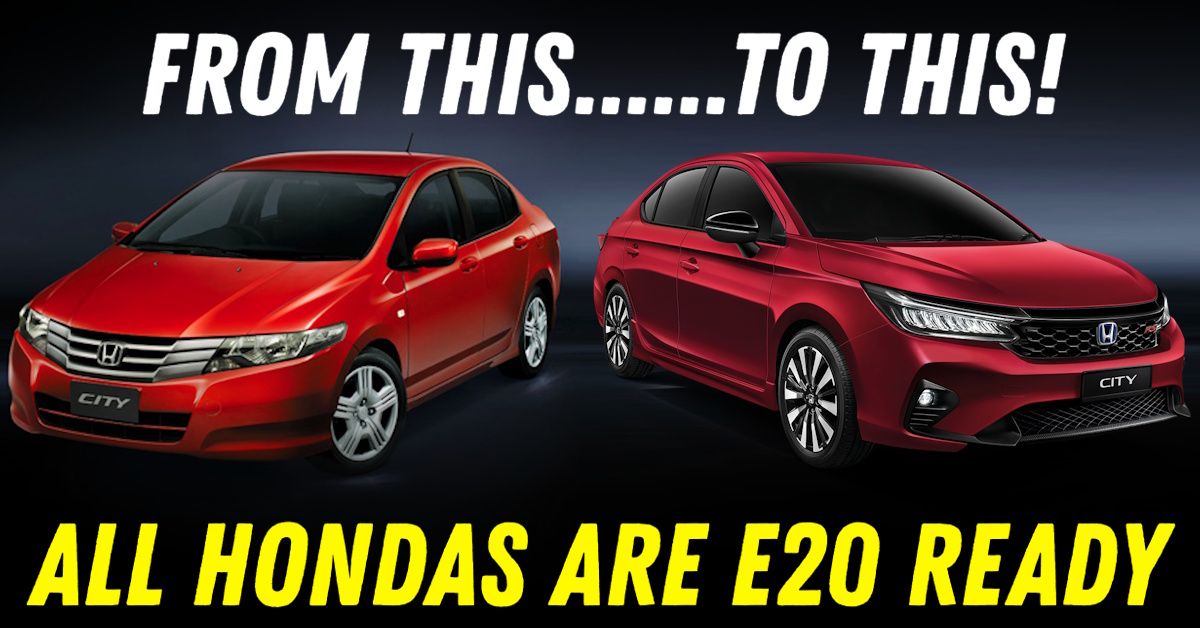
Only Honda Used Cars Are Safe To Buy In 2026, As They Are E20 Compatible From 2009!

In 2025, buying a used petrol car is trickier than it was a few years ago, and the main reason is fuel. With E20 petrol now common at pumps, many older cars are quietly operating on a blend they were never designed for. In that landscape, Honda stands out, which is why a used Honda built after 1 January 2009 has become one of the safest picks in the market.
Honda Cars India says that every car it has manufactured here since 1 January 2009 is “E20 material compatible”. That covers the City, Amaze, Jazz, WR-V, Elevate and older models like Brio, Mobilio, BR-V, Civic, CR-V and Accord, as long as they were built from that date onwards.
Material compatibility is the key phrase. Ethanol is more corrosive than pure petrol and can attack rubber hoses, seals, gaskets and some metals in the fuel system.
When a manufacturer calls a car E20 material compatible, it is saying that the plastics, rubbers and metals used in tanks, lines, pumps and injectors have been chosen and tested to live with the higher ethanol blend over time. In simple terms, you should not have to worry about fuel hoses hardening early or the fuel pump failing just because the fuel at your local pump changed.
This clarity is unusual. It gives buyers a firm cut-off date and a clear rule: if the Honda was made in India on or after 1 January 2009, its fuel system materials are rated for E20.
For many other brands, full E20 compatibility only arrives with models built from early 2023 or April 2023, in line with BS6 Phase 2 and RDE norms. Before that, the answers in owner manuals and at service centres tend to be vague. Buyers are told to “check the manual” or are warned that damage from using the wrong fuel may not be covered under warranty. That leaves a large part of the used-car market in a grey zone.
Maruti Suzuki, for example, officially says that all petrol models built from April 2023 onwards are E20 compliant from the factory. For older cars, it is working on retrofit kits that will replace vulnerable parts such as fuel lines, seals and gaskets with ethanol-resistant components. That sounds promising, but until those kits are actually launched and priced, a used-car buyer does not know exactly what needs to be changed, when, or at what cost.
Volkswagen and Skoda say that all BS6 petrol cars sold after 1 April 2020 use components compatible with E20 and that running these on E20 will not void warranty. For older vehicles, they admit that parts were not evaluated for E20, but point to test data that suggests no major impact. At the same time, they reserve the right to deny support where failures are linked to a violation of manufacturer guidelines. It is not the sort of black-and-white assurance that makes life easy for a used-car buyer.
As fuel companies switched from E10 to E20 at pumps, owner complaints rose. Social media and forums filled up with reports of big drops in mileage and worries about engine damage. Some users say fuel economy has fallen by 15 to 20 percent after the switch, even though controlled tests suggest a smaller average drop of around 1 to 6 percent. There are also scattered reports of fuel-system issues in older cars that were never designed around higher ethanol blends.
The government’s position is that E20 is safe in properly maintained vehicles. It has clarified that cars sold before April 2023 were designed for E10, and from that date onwards they are E20 material compatible. A joint panel of government and industry has also said that using E20 by itself does not void vehicle warranty. Even so, owners of older cars are effectively forced to use a fuel that their vehicles were not originally built for, which creates understandable anxiety.
This is where Honda’s stance matters. The company has publicly and repeatedly said that all its India-built cars from 1 January 2009 are E20 material compatible. Enthusiast discussions note that Honda is one of the few manufacturers to extend clear E20 assurance so far back into its model history rather than drawing the line at 2020 or 2023.
Take a buyer choosing between three 2013 models: a Honda City, a Maruti Swift and a Volkswagen Vento. All three are mechanically sound and well kept. With E20 at the pump, the City comes with an official statement that its fuel-system materials can handle the blend.
The Swift may eventually be covered by a retrofit kit, but details are still pending. The Vento has some reassurance from brand-level guidance, but no direct, model-specific guarantee that its components were designed around E20. In that scenario, the Honda is simply the least stressful choice.
This does not mean every Honda is automatically trouble-free. A 2009 or 2010 car will still have age-related wear and tear, and items such as suspension bushes and rubber hoses may need attention. E20 compatibility is not a magic shield against neglect. It only means that, at a material level, the fuel system was engineered from day one to live with E20.
Even so, if you want a used petrol car in 2025 that can handle a decade of E20 without special parts or constant worry, the logic is straightforward. Look for a Honda built after 1 January 2009, check its service history carefully, and you have removed one of the biggest new unknowns in the used-car market.